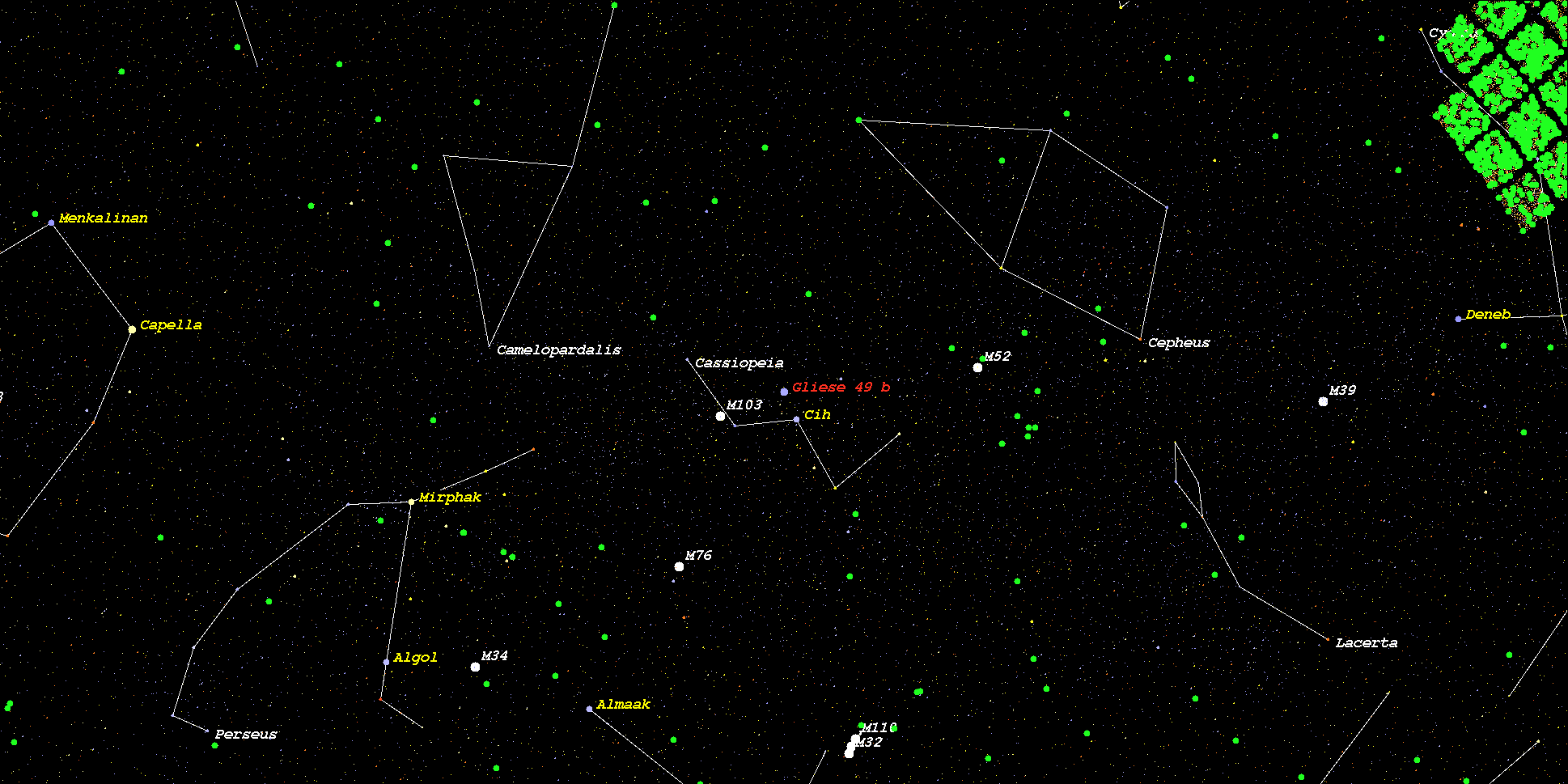
Gliese 49 is a star in the northern constellation of Cassiopeia. Visually, it is located 106 arcminutes north of the bright star γ Cassiopeiae. With an apparent visual magnitude of 9.56, it is not observable with the naked eye. It is located, based on the reduction of parallax data of Gaia (101.47±0.03 mas), 32.1 light-years away from the Solar System. The star is drifting closer to the Sun with a radial velocity of −6 km/s.
This object is a red dwarf star of spectral type M1.5V. Much dimmer than the Sun, it has a total luminosity that is 4.9% that of the Sun; it is, however, much brighter than other nearby red dwarfs such as Proxima Centauri or Wolf 359. It has an effective temperature of 3,805±51 K. Its mass is 52% that of the Sun, and 51% of its radius.
It rotates on its axis with a projected rotation speed of under 2 km/s, and has a rotation period of 18.86 days. It has a metallic content similar to that of the Sun, with its index of metallicity [M / H] = 0.03. Although its age is not known exactly, it is younger than 250 million years.
Gliese 49 has a similar proper motion to the red dwarf flare star V388 Cassiopeiae. The visual separation between the two is 295 arcseconds, which implies that the real distance between them is over 2,900 AU. Both stars are associated with the Hyades, as suggested by its young age and chromospheric activity levels.
Planetary system
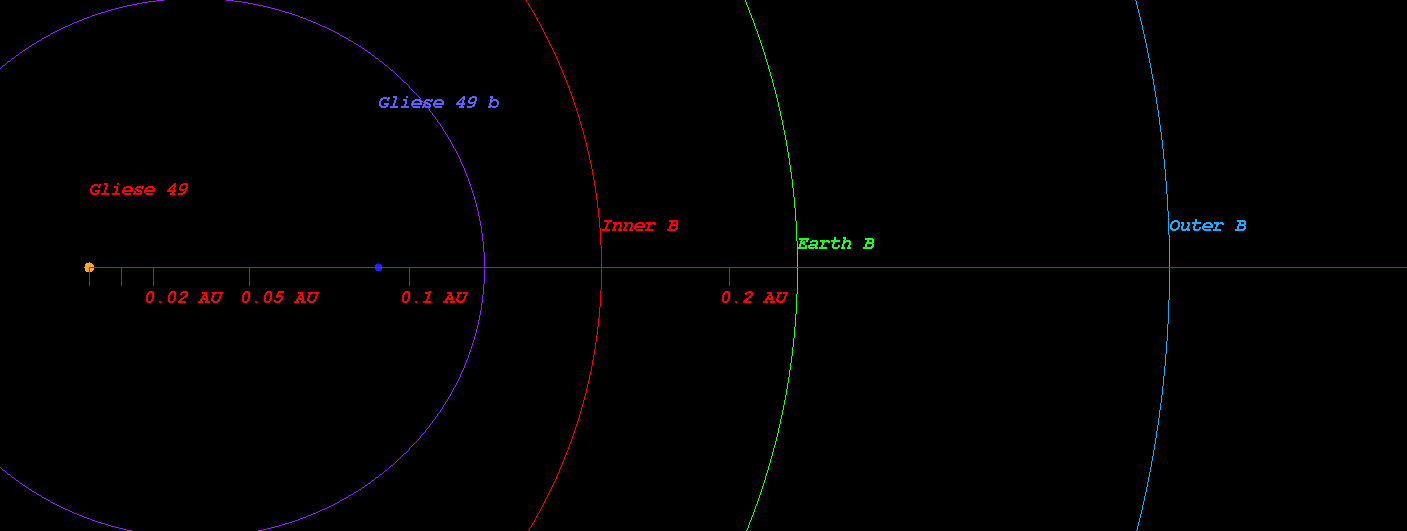
One known planet is known to orbit Gliese 49. Gliese 49 b is a super-Earth planet detected by the radial velocity method.
References