Six Flags Entertainment Corporation is an American amusement park company headquartered in Charlotte, North Carolina, United States. It was formed on July 2, 2024, following a merger between longtime rivals Cedar Fair and the former Six Flags company. The combined company owns and operates 51 properties throughout North America, including amusement parks, water parks, and resorts.
History
Pre-merger
Six Flags Theme Parks originated with the creation of The Great Southwest Corporation by Angus G. Wynne and other investors, who would go on to open the chain's original park, Six Flags Over Texas, in August 1961. After the Pennsylvania Railroad gained a controlling stake in the company's shares, a handful of new parks were constructed, and multiple independently-owned parks were purchased over the following two decades. Following the acquisition of Marriott Corporation's Great America theme park in 1984, Six Flags acquired the rights to feature Warner Bros.' Looney Tunes animated characters at their properties; Time Warner (now Warner Bros. Discovery) subsequently purchased much of the company and was its sole owner from 1993 to 1995. Six Flags Theme Parks, Inc. was later bought out by Premier Parks – an Oklahoma-based real estate firm and theme park chain – on April 1, 1998, for $1.86 billion. Premier began to apply the Six Flags name to several of their existing properties in North America and Europe, eventually fully assuming the brand name in 2000.
Throughout the 2000s, Six Flags began to suffer from growing debt and organizational bloat, eventually resorting to selling off assets like its European parks and Worlds of Adventure in 2004. Some of the company's largest investors grew frustrated with Six Flags and demanded change; Daniel Snyder's Red Zone, LLC successfully gained control of Six Flags' board of directors in 2005 by means of a proxy battle. New management continued to sell off various American amusement park locations throughout 2006-2007, although their cash flow continued to decrease, falling $120 million annually under Red Zone's board. Weighed down by the financial crisis of 2007–2008 part of the Great Recession, and the New York Stock Exchange's decision to delist their stock, Six Flags filed for Chapter 11 bankruptcy protection in 2009 but continued to operate the parks as normal. Six Flags re-emerged as Six Flags Entertainment Corp. on May 3, 2010, moving head offices from New York City to Grand Prairie, Texas and allowing lenders to control 92% of the company in exchange for canceling $1.13 billion in debt.
Jim Reid-Anderson was instated as chairman, president and chief executive officer (CEO) on August 13, 2010 and succeeded by Mike Spanos in late 2019. New initiatives were launched to build Six Flags theme parks in global markets; the previously cancelled Six Flags Dubai was revived in 2014 before being called off again in 2018. Six Flags Zhejiang and Six Flags Chongqing both began construction in China before a declining real estate and the collapse of its local investment firm in 2020 forced both projects to be sold on to other developers. The COVID-19 pandemic also hindered Six Flags' operations during 2020, forcing many parks to remain closed for the year. Mike Spanos stepped down in 2021, allowing chairman Selim Bassoul to assume the role of CEO. Seeking reinvention, Bassoul announced a new strategy favoring guest experience over capital investments; this meant raising prices in order to lower daily park crowds, thus improving the park experience for higher-paying guests. The initiative and various comments made by Bassoul proved controversial with shareholders, and was abandoned in November 2022 after park attendance plummeted by 33%.
Cedar Fair
Merger
Previous unsuccessful attempts had been made to assimilate Cedar Fair in the decade leading up to the merger. One such deal with Apollo Global Management fell apart in April 2010. On October 2, 2019, Reuters reported that Six Flags had first approached Cedar Fair with a cash-and-stock acquisition offer, although the proposal was quickly rebuffed. In February 2022, SeaWorld Parks & Entertainment (now United Parks & Resorts) made an unsolicited all-cash bid to buy Cedar Fair for $3.4 billion; the offer was rejected two weeks later.
Six Flags and Cedar Fair eventually merged in 2024 after announcing the pending agreement in 2023. Described as a "merger of equals", the combined company retained the Six Flags name, formed a net worth of $8 billion, and created a portfolio of 27 amusement parks, 15 water parks, and 9 resort properties. The transition resulted in Cedar Fair stakeholders becoming majority owners, with "unitholders" owning a 51% stake in the new company. President and CEO of Cedar Fair, Richard Zimmerman, became President and CEO of the new combined company, while Selim Bassoul, former President and CEO of Six Flags, became the executive chairman of the company's board of directors. The combined company's new headquarters is scheduled for relocation to Charlotte, North Carolina, with significant administrative and financial operations being located at Cedar Fair's former headquarters in Sandusky, Ohio. The merger was completed on July 1, 2024.
Properties
Year acquired lists the year the property was acquired by the property's previous respective owner among the current company's two predecessors.
Amusement parks
Water parks
Outdoor
Indoor
Safari Parks
Resorts
Upcoming properties
Amusement parks
Fast Lane
Fast Lane is an expedited queue system in use at parks formerly associated with Cedar Fair. It was first announced for Kings Island on July 18, 2011. The park served as the testing park for the system. For an increased cost, visitors get a wrist band which gives them the ability to wait in a shorter queue for most attractions. Originally, it could only be used from noon to 7:00 PM, but it was soon expanded to be available all day. Fast Lane would be rolled out to all Cedar Fair parks for the 2012 season. There is also Fright Lane, which is Fast Lane for the haunted attractions during the Halloween events. For the 2016 season, Cedar Fair began testing all season Fast Lane at Valleyfair and Dorney Park. By the 2019 season, all parks offered all season Fast Lane.
The Flash Pass
The Flash Pass is an optional, pay-per-person virtual queue system offered at amusement parks operated by Six Flags before the merger. The system, named after DC Comics character The Flash, allows guests to reserve places in line at participating attractions, and access must be purchased for a nominal fee in addition to the general park admission price. The first iteration, called Q-bot, was designed by Lo-Q and was first implemented at Six Flags Over Georgia in 2001. Guests are given handheld devices, which are then used to make reservations and receive notifications when it is their turn to ride. Another iteration is where guests can scan a QR code on in-park signs or through the mobile app, and guests can buy individual Flash Passes per ride or use their season pass or membership Flash Pass. This feature was adopted in 2021.
A water park version of the virtual system called Q-band was first tested at Six Flags White Water in 2011. Guests wear waterproof RFID wristbands that can be scanned at kiosks near participating water park attractions.
See also
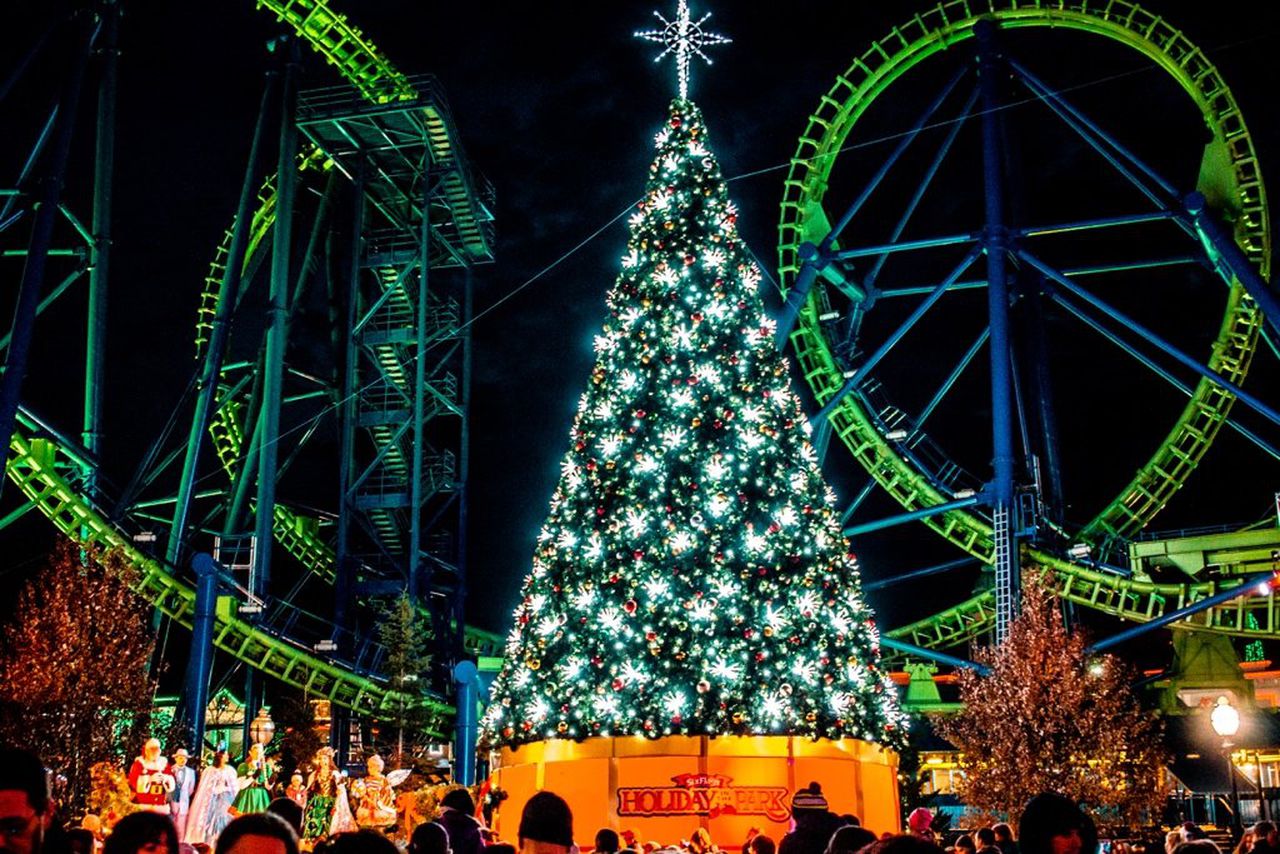
- Holiday in the Park
- Incidents at Six Flags parks
- Six Flags Fright Fest
References
External links
Official website