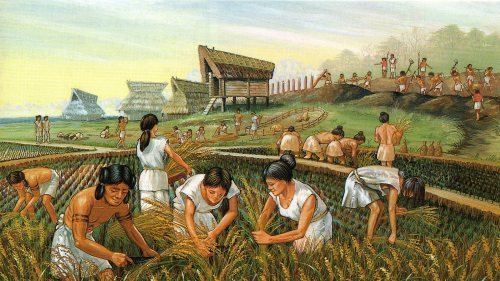
The Yayoi people (弥生 人, Yayoi jin) were an ancient people that immigrated to the Japanese archipelago during the Yayoi period (300 BC–300 AD) and are characterized by the existence of Yayoi material culture. Some argue for an earlier start of the Yayoi period, between 1000 and 800 BC, but this date is contested. The people of the Yayoi culture are regarded as the spreaders of agriculture and Japonic languages throughout the whole archipelago and had both local Jōmon hunter-gatherer and mainland Asian migrant ancestry.
Origin
The terms Yayoi and Wajin can be used interchangeably, though Wajin (倭人) refers to the people of Wa, and Wajin (和人) is also used as a name for the modern Yamato people.
The definition of the Yayoi people is complex: Yayoi describes both farmer-hunter-gatherers exclusively living in the Japanese archipelago and their agricultural transition. Yayoi people refers specifically to the mixed descendants of Jōmon hunter-gatherers and mainland Asian migrants, who adopted (rice) agriculture and other continental material culture.
There are several hypotheses about the geographic origin of the mainland Asian migrants:
- immigrants from the Southern or Central Korean peninsula
- immigrants from Jiangnan near the Yangtze River Delta in ancient China
- multiple origins from various regions of Asia, including Southeast Asia
According to Alexander Vovin, the Yayoi were present in the central and southern parts of Korea before they were displaced and assimilated by arriving proto-Koreans. A similar view was raised by Whitman (2012), who further noted that the Yayoi are not closely related to the proto-Koreanic speakers and that they arrived in Korea later from Manchuria around 300 BC and coexisted with proto-Japonic speakers. Both influenced each other, and a later founder effect diminished the internal variety of both language families.
Jared Diamond, the author of Guns, Germs, and Steel, suggested that immigrants from the Korean Peninsula initiated the Yayoi period in Japan. Citing research findings, he stated that Yayoi Japan likely received millions of immigrants from Korea. These immigrants, during the Yayoi transition, are believed to have overwhelmed the genetic contribution of the indigenous Jōmon people, whose population was estimated to be around 75,000 at that time.
In recent times, through archaeological and genealogical research, Japanese scholars have largely associated the origin of the Yayoi people with the Korean peninsula and have stated their impact in terms of shared ancestry between the two modern populations.
Lifestyle
The Yayoi population is believed to have been heavily agricultural and shamanistic oriented, being thought to be the precursor of Shintoism, worshipping animals and spirits. Though the origins are still debated, the Yayoi group is believed to have been the people who first introduced rice farming to Japan.
Genetics
Summary
The Yayoi period population is inferred to have been culturally close to the pre-Koreanic Mumun pottery period populations of the southern Korean peninsula, which may have been speakers of Peninsular Japonic languages. Genetically, the Yayoi group is often associated with the Y-Haplogroup O1b2 (SRY465, M176) [ja] which is commonly found in modern day Japanese and Korean populations. Anthropologically, it is considered to be genetically diverse and can be divided into three separate, but related groups: early-Yayoi (弥生初期), middle-Yayoi (弥生中期), and late-Yayoi (弥生後期) settlers. Although the groups all share the unique O1b2 ancestry, early-Yayoi period people possessed more Jōmon ancestry whereas the later-Yayoi settlers possessed more mainland Asian ancestry with the latter bearing heavy resemblance with ancient Koreans from the Three Kingdoms period.
Impact on modern populations
Genetically, the Yayoi people (especially the later-Yayoi settlers) are believed to be a major component of the genetic makeup for the modern Japanese people and are believed to be the contributing factor for the diminishment of the previously dominant Jōmon ancestry, commonly associated with the mtDNA Haplogroup M7a [ja]. Today, modern Japanese people possess around an average of 9% (±3%) of Jōmon ancestry with the highest reaching around 12%. In comparison, Koreans possess more Yayoi ancestry than the Japanese, only carrying 6% (±3%) of Jōmon ancestry in total, sometimes going low as 3%.
Physical appearance
Early Yayoi immigrants had often wholly large and flat features, large facial height, round eye orbits, and large teeth, while other early Yayoi specimens, such as those from the Shinmachi Dolmen Cluster displayed features closer to the earlier Jōmon people, such as a shorter face, short stature, and Jōmon-style tooth extraction. One Yayoi specimen reconstructed in 2025 displayed transitional features, retaining the characteristics of a Jōmon person, but also having other characteristics such as less prominent cheekbones and a longer face.
Sea people
Some historians call the Yayoi people the "Sea people (海人族/Kaijinzoku or Amazoku, 海神族/Watatsumizoku)," postulating that they migrated to Japan via the sea from elsewhere. This idea began with finding Kara-styled bronzewares and shipwreck remains on the coasts of the Korean peninsula, prompting some historians to suggest that there was a group of seafaring people who entered Japan via Korea from the seas during the Yayoi period.
Multiple theories about their geographic origin exist, including the Korean peninsula, Southeast Asia, and South China. However, the theory of the Sea people is deemed merely hypothetical due to lack of evidence, and support for it has diminished over the years in favor of more grounded descriptions in terms of the Yayoi people.
Language
See also
- Japanese people
- Yayoi culture
References